From the author
“Or is it all scams?”
"You work with TikTok, right?"
My cousin had pulled me aside while everyone else was clearing the plates at my mom's birthday dinner. She was still holding a dish towel she'd forgotten to put down.
"Could someone like me actually make some money on there?" She laughed a little, like she was embarrassed to ask. "Or is it all scams?"
This spring her company closed. It was a small agency that wrote product descriptions and ads for online shops. She'd been there nine years. Then AI tools started doing the same work in seconds, the clients drifted away, and one Friday the owner called everyone into the little kitchen and said it was over.
I didn't give her a good answer that night. I knew the answer. I just had nothing to send her. Everything online was either hype or a year out of date.
That bothered me more than I expected, because I see the answer every day. I work at an e-commerce company that sells on TikTok. I talk to creators, I read the sales dashboards, and I'm one of the people who decides who gets free products to try. I've watched a 15-second video of nothing but a pair of hands sell hundreds of orders in a week. I've watched an ordinary office worker go from zero followers to commissions coming in every month.
The door is a lot closer than most people think.
And there's a twist I keep coming back to. The same technology that took my cousin's job can now do the most boring half of this new one for her.
So I wrote down everything I would tell her. This book is that answer.
— Mark
Chapter 1
The Money Hiding in Your For You Feed
It's 9:40 on a Tuesday night. Anna is in bed, scrolling, trying not to think about the email from work.
The email said her company is "rolling out AI tools to support the team." Two people in her department weren't replaced when they left last spring. Her salary hasn't moved in three years. Nobody has said her job is at risk. Nobody has said it isn't, either.
On her screen, a woman in a gray hoodie holds up a little lint remover, runs it down the sleeve of an old sweater and shows the fuzz piling up. Twelve seconds. No music, no fancy editing. Under the video sits a small orange shopping bag.
Anna stops. She bought one of those last month, from a video almost exactly like this one. For the first time she wonders whether that woman got paid when she bought it.
She did. And that small orange bag is what this book is about.
If the ground feels a little shaky
Maybe you haven't lost your job. Most readers of this book haven't.
But maybe you've noticed the same things Anna has. Your company is testing AI for writing, customer service or translation. A colleague left and the role quietly disappeared. Prices went up and your pay didn't.
You don't need to panic about any of that. What you probably want is something simpler: one card in your hand that you control. A second income that doesn't depend on your boss, your manager's budget or the next round of "restructuring."
That's what this book is about. It starts with how the money works.
How the money works
The whole thing fits in four steps:
- You make a short video showing a product you like.
- You attach a special link to that product.
- Someone watches, taps the link and buys.
- The seller pays you a share of the sale. That share is your commission.
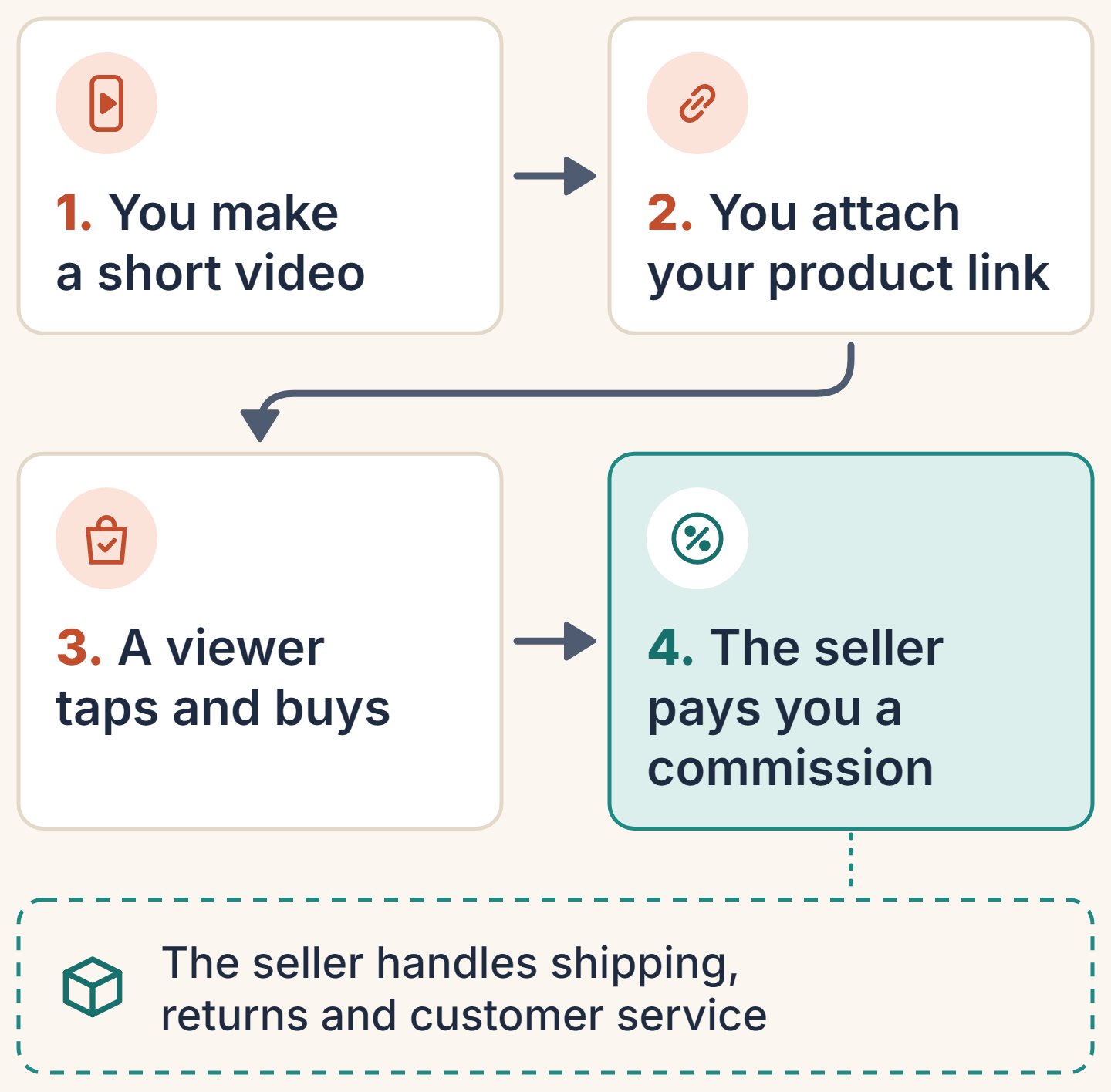
That's affiliate marketing on TikTok.
You never buy stock, and you never pack a box. Shipping, returns and customer emails all stay with the seller. Your only job is the video.
And a video doesn't stop working when you stop looking at it. People keep finding it days and sometimes weeks later. In the dashboards I see at work, plenty of the sales on any given day come from videos posted weeks earlier by creators who have long since moved on to their next one.
The math
Let's make it concrete. Commission rates vary from product to product, and you see the exact rate before you choose anything. But say you show a $24 kitchen gadget with a 15% commission.
That's $3.60 every time someone buys through your link.
If one video sells 30 of them over a few weeks, that's $108 from 30 seconds of footage you filmed on a Sunday afternoon. Make ten videos like that and the numbers start to stack up, because each one keeps selling on its own schedule.
Not every video will sell. Some will sell nothing at all. But you only need some of them to work, and the ones that do keep earning while you make the next one. That's what makes this different from trading hours for dollars.
Why this is one of the best ways for ordinary people to start
I've seen a lot of side hustles from the inside of e-commerce. Here's why I'd point someone I love toward this one first.
You don't need money to start. No stock to buy, no rent, no ad budget. The worst case is that you spend some evenings and learn a skill.
Everything you need is already in your pocket. One phone films, edits and posts.
Someone else handles the hard parts. Shipping, returns and customer service are the seller's problem.
You can keep your job. A few hours a week is enough to start, which most people can find in evenings or one weekend afternoon.
You don't have to show your face. Many of the videos that sell best show nothing but hands, a product and a voice. Chapter 6 shows you exactly how.
The time you put in turns into a skill that keeps its value. Explaining a product clearly, understanding why people buy and making a short video that holds attention are the kind of skills that get more valuable as AI takes over routine work, not less.
And the downside is small while the upside stays open. The worst outcome is that you learned something. The best outcome is a second income that keeps growing.
How it compares
If you're short on money and time and don't have a business background, here's how the usual options stack up. (No disrespect to anyone doing these. Plenty of people make them work. This is about where a beginner with little money can start most easily.)
| Option | Money you risk upfront | When it pays | Keeps earning when you stop? | Main catch for a beginner |
|---|---|---|---|---|
| Online store / dropshipping | Stock, ads, apps | After you've spent | Only while you keep spending | You can lose real money fast |
| Freelance writing, design, translation | Little | Per job | No | You're now competing with AI for the same work |
| Delivery and gig apps | Car, fuel, phone | Per hour | No | Stops the moment you stop |
| "Join my team" programs | Starter kits, fees | Mostly for the people above you | Rarely | Often you're the customer, not the business |
| TikTok affiliate | Close to nothing | Per sale, from your videos | Videos can keep selling | Takes some weeks of practice to get going |
The conclusion isn't that this path is easy. It's that it has the lowest cost to start and the shortest distance between "I've never done this" and "I made my first sale."
Why now
Three changes over the last couple of years have tilted things toward ordinary people.
First, polished stopped winning. When brands look at which videos actually sell, it's rarely the slick studio ones. It's someone at a normal kitchen counter or in a normal car, showing how a thing works. Buyers trust people more than ads, which means your nothing-special setup is exactly what sells.
Second, TikTok shows your videos to strangers. On most social apps, your posts mostly reach people who already follow you. TikTok's main feed, the For You page, shows videos to people who have never heard of you. That's why a brand-new account can reach thousands of people with its tenth video.
Third, shopping inside TikTok keeps spreading. In June 2026 alone, TikTok Shop opened in Austria, Belgium, the Netherlands and Poland, joining the UK, Ireland, France, Germany, Italy, Spain and the United States. Sellers keep adding products, and every one of those products needs someone to show it.
That someone can be you.
Meet your first employee
There's one more reason this is a better moment than ever before, and it's a bit ironic.
The technology that's making a lot of people nervous about their jobs can now work for you. Free AI chat tools like ChatGPT, Claude or Gemini can write your video ideas, your hooks, your scripts and your captions in seconds.
Think of it as your first employee. It works fast, costs little or nothing and never gets tired. You're the boss. Your employee drafts. You decide, test the product with your own hands and make the final call. With that split, one person and a phone can work like a small team.
Here's your first instruction to your new employee. Copy it into any AI chat app tonight:
AI prompt · copy this
I want to start making short TikTok videos recommending useful products. Ask me 5 questions about my daily life, hobbies and the things I buy, then suggest 5 product areas I could make videos about.
You'll see it in action in every chapter of this book.
How fast can this go?
Faster than most people think, and mostly for reasons you control.
The biggest factor is where you start. If you already have a TikTok account with some followers, even an old one you barely use, you may be much closer to your first commission than you think. Chapter 3 shows you how to check.
The second is what you sell. A product that shows a visible result in a few seconds, fixes a real annoyance and costs about what people spend on impulse can sell from a fairly ordinary video.
The third is how steadily you work. Someone who posts four or five videos a week and adjusts based on what works will move much faster than someone who posts once and waits.
That gives you three common speeds.
The head start: you already have followers, from an old account or a hobby you've posted about for years. With the right product, a first sale can come within days to a few weeks. Sofia, who you'll meet in a moment, is this lane.
The fast start from zero: you have no followers, but you follow the blueprint in this book, post four or five videos a week and pick products that show results on camera. A first sale usually comes in around six to eight weeks. That's Leo.
The slow start: you post when you feel like it, a video here and there, with no clear plan. It can still work, but it takes months.
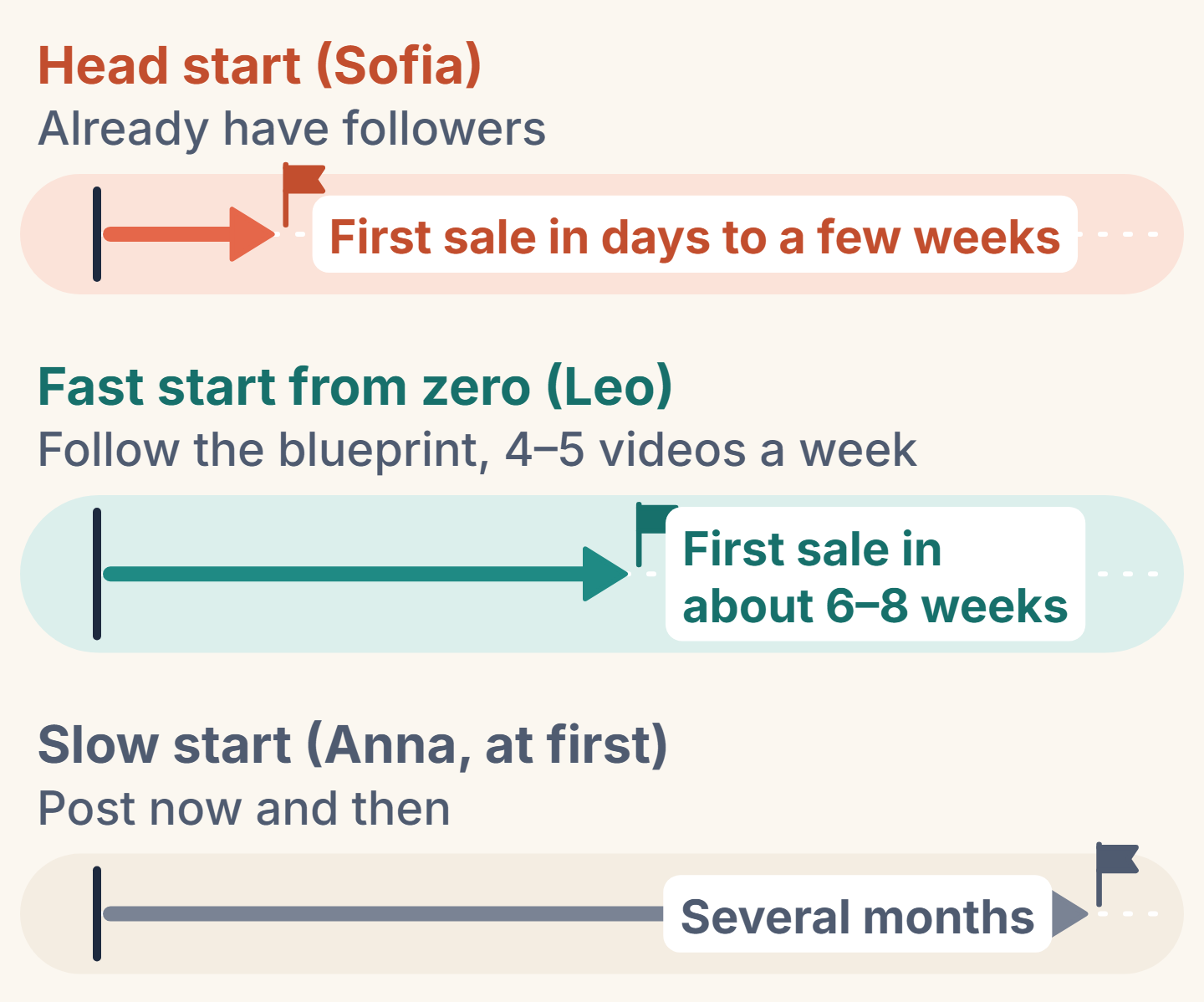
This book is built to put you in one of the first two lanes, and to pull you out of the third if that's where you've been.
The fast lane for people starting at zero
Most readers don't have an old account to fall back on. Good news: there's a fast lane for you too, and it doesn't depend on luck.
When you start at zero, your accelerator is reaching the follower bar sooner. Three things decide how quickly that happens, and you control all three. You pick a product you can show working within the first few seconds of a video. You post four or five videos a week instead of one now and then. And you build every video on the same proven blueprint (Chapter 6) instead of guessing each time.
Leo is the example you'll follow. Zero followers, no plan to ever show his face and a warehouse schedule that changes every week. What he does have is a clear corner (cheap gadgets and tools that actually work), products that show a result in seconds and a simple routine: two filming sessions a week, five short videos, every one built on the blueprint. That's the whole system. It took him from zero to 1,000 followers in about six weeks, with his first sale a week later. You'll see exactly how he did it in Chapter 7.
Leo's six weeks won't be everyone's six weeks. Your corner, your products and how steadily you post will set your own pace. But the method is the same, and it's yours to copy.
Meet the three people you'll follow
Throughout this book you'll follow three beginners, each starting from a different place. They're composite characters, built from the kinds of people I've watched start out. You'll probably recognize yourself in at least one.
Sofia, 33, stay-at-home parent. For two years she's posted home tips on TikTok just for fun, kid-free, and she has a little over 1,000 followers without ever trying. Friends constantly ask where she buys things. She can get views. She has no idea how views turn into money. She's our head start.
Leo, 26, warehouse shift worker. His shifts keep getting cut, and he'd rather do almost anything than show his face on camera. He loves gadgets and tools and has zero followers. He's our fast start from zero.
Anna, 38, office worker. The one you met on page one. A full-time job, a long commute, about 30 minutes on weeknights and a free Sunday afternoon. She's never posted a video in her life. She'll start in the slow lane, posting whenever she finds the energy, and nearly give up. Then she'll switch to Leo's routine, hand the writing to her AI employee and watch her curve bend upward. Her story shows you how to move from slow to fast.
The one question that separates the earners from the ignored
From the brand side, I see two kinds of creators.
The first kind gets a burst of sales, then fades. Their comments fill up with "broke in a week" and "doesn't work like the video." Sellers stop sending them products.
The second kind sells a little, then a little more, for months and years. Viewers come back, sellers invite them back and their income grows while everyone else's spikes and crashes.
The difference is one question the second kind asks before every video: Would I say this to a friend?
I call it the Friend Test, and it shapes everything in this book. You recommend what you'd buy yourself. You show it as it really is, downside included. When a link pays you, you mention it in the video, the same way you'd tell a friend "full disclosure, I get a little from this." You never scare people into buying, and your family stays off camera unless they truly want to be on it.
If you've ever felt a little awkward about "selling stuff online," this takes care of that too. You're not selling. You're recommending something you'd tell a friend about anyway, and the seller says thank you.
Try This: your first 10 minutes
Open TikTok and scroll for 10 minutes. Every time you see a video with a product in it, notice two things: whether you trusted the person, and what they showed you rather than just told you.
Save the one video that made you want to buy. Then copy the prompt from "Meet your first employee" into an AI chat app and answer its five questions.
By the time you finish, you'll have five product areas that fit your life, and one saved video that you'll understand completely by Chapter 6.
Enjoying it? Get all 13 chapters for $9.90, or just keep reading.
Chapter 2
Six Myths and One Map
Leo is in the warehouse break room with twenty minutes left on his break, watching his fourth YouTube video of the week about making money on TikTok.
The first one said he'd need 10,000 followers. The second said he'd need to "build a personal brand," which sounded like it involved his face. The third spent eleven minutes on mindset and then tried to sell him a $997 course. The fourth was in a language made of letters: GMV, CTR, FYP.
He puts his phone face down on the table. He's more confused than before he started, and a little more sure that this is for other people.
It isn't. Leo's problem isn't the work. It's six beliefs he's picked up along the way, and every one of them is wrong.
Myth 1: "You need a big following before you can earn anything."
This is the one that stops the most people, and it's the one I'd most like to delete from the internet.
To get affiliate links on TikTok Shop in the US, you need 1,000 followers. That's the bar. Not 10,000 or 100,000. And plenty of creators who sell well every week have fewer followers than your old school had students.
Here's why. On TikTok, many of the people who buy from a video don't follow the creator at all. The For You page puts your video in front of strangers who happen to need what you're showing. A small account with a clear, useful product video can outsell a big account doing a dance with a product in the background.
And if you've had a TikTok account for a while, you might already be past the bar. Chapter 3 shows you how to check in two minutes.
Myth 2: "You have to show your face."
You really don't.
Some of the best-selling videos I've seen at work never show a face at all. The camera looks down at a pair of hands using the product. A voice explains what's happening. Sometimes there's no voice at all, just text on screen and the satisfying sound of the thing doing its job.
That 15-second video I mentioned at the start of the book, the one that sold hundreds of orders in a week? Hands only.
Leo will build his whole account this way. Chapter 6 shows you every faceless style and how to film each one.
Myth 3: "You need money to start."
Start by looking around your home. The kitchen gadget you use every day, the car organizer, the cable clips, the lunchbox that finally doesn't leak. Your first five videos can come from things you already own.
Later, once you're set up, sellers will often send you products for free in exchange for a video. That's a normal part of how this works, and Chapter 8 explains how to get them.
Myth 4: "You need to be good at editing."
The videos that sell are usually the simplest ones. Most are a few short clips joined together, with a line of text on screen and captions.
If you can trim a clip on your phone, you can do this. The free editing app CapCut, or TikTok's own built-in editor, covers everything you'll need. You'll learn the four things that matter in Chapter 12, in about ten minutes.
Myth 5: "You need talent, charisma or good looks."
What sells is clarity. Show the problem, show the product fixing it, say honestly what you think. That's a skill anyone can learn, and it gets easier with every video.
The creators I see selling steadily aren't the funniest or the most attractive. They're the ones who explain things the way a friend would at the kitchen table. Plenty of them are noticeably nervous on camera, and their viewers trust them more for it.
Myth 6: "It's too late. Everyone's already doing it."
From the outside it looks crowded. From the inside it looks very different.
New products land on TikTok Shop every day, and every one of them needs someone to show it. TikTok Shop opened in four new European countries in June 2026 alone. And sellers like the company I work for are always looking for new creators, because the big names are expensive and their audiences are already tired of seeing the same faces.
The top of the mountain is crowded. Your corner of it, a specific kind of product shown to a specific kind of person, usually isn't.
The map
With those six out of the way, here's the whole path from zero to paid. Every successful TikTok affiliate goes through these same six steps, whether they've ever written them down or not.
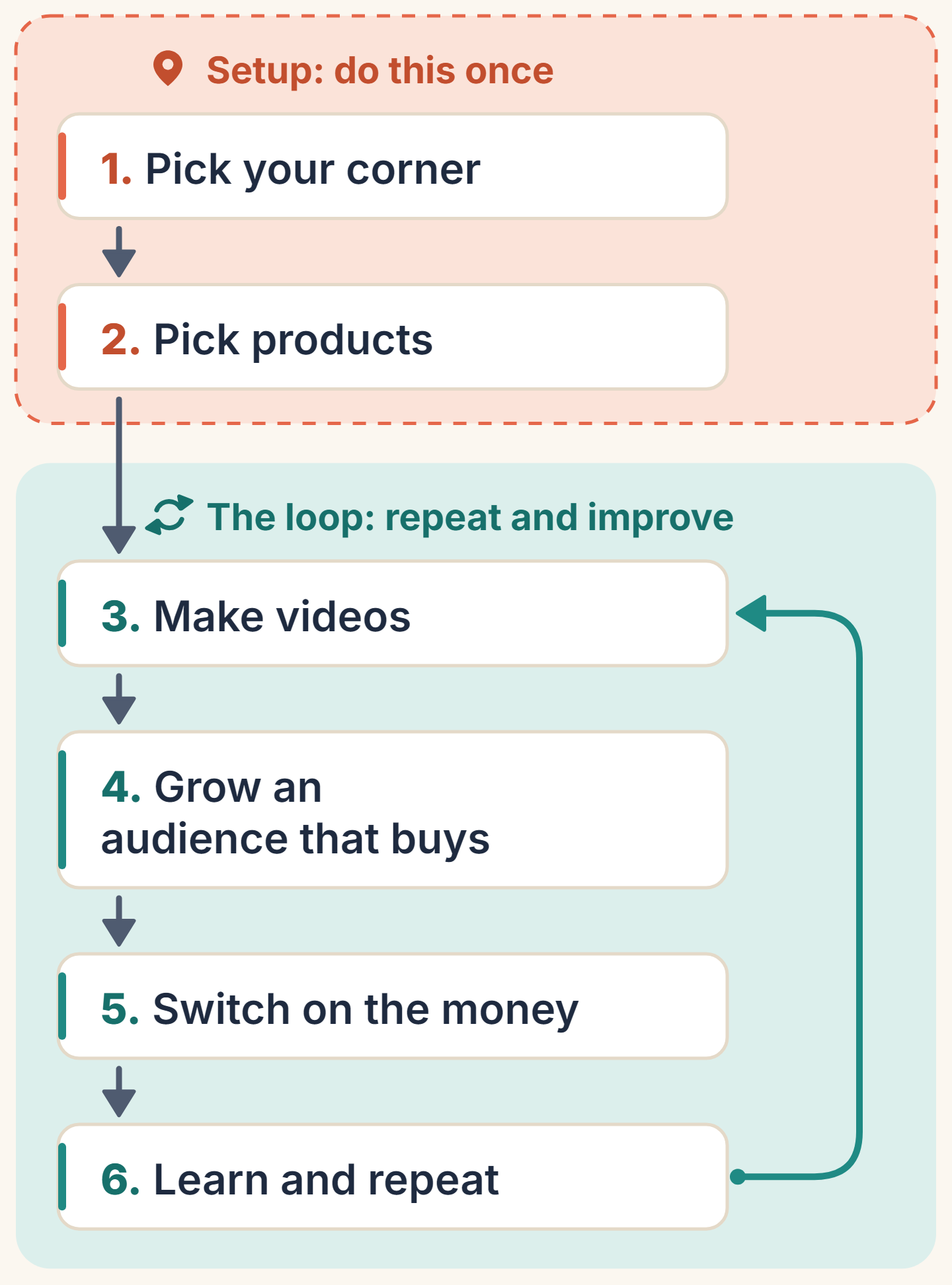
① Pick your corner. The one area your account is about, like small-kitchen fixes or budget tech. It takes an evening, and Chapter 4 gives you a 15-minute test.
② Pick products. Things you can show working on camera that fix a real annoyance. Chapter 5.
③ Make videos. Short, clear, usually under 40 seconds. Chapter 6 gives you the exact blueprint.
④ Grow an audience that buys. People who follow you because you solve problems they have. Chapter 7.
⑤ Switch on the money. Join TikTok Shop's affiliate program or Amazon's, and attach your first link. Chapter 8.
⑥ Learn and repeat. See which videos worked, make more like them and drop what didn't. This is where beginners turn into earners.
Notice the loop. Steps 3 to 6 are a cycle you go around again and again, a little better each time. Everything before the loop is setup, and you can finish the setup this week.
The step almost everyone skips
Most beginners jump straight to step 5. They search "how to join TikTok Shop affiliate" before they know what their account is about. Others jump to step 3 and post anything: a recipe on Monday, a phone case on Wednesday, a joke on Friday.
Both groups get stuck for the same reason. They skipped step 1.
When your account is clearly about one thing, everything else gets easier. Viewers know why they should follow, you never run out of ideas and it's obvious which products fit. It's the cheapest, fastest win in this whole book.
Where our three are on the map
Sofia is already at step 4. She has a corner (home tips), an audience and products she loves. She's one step away from the money, and in the next chapter she'll take it.
Leo is at step 1, and he's closer than he thinks. Gadgets and tools are his corner. He just doesn't know it yet.
Anna is before step 1. She doesn't know what she'd make videos about. By the end of Chapter 4, she will.
Try This: find yourself on the map
Look at the map and mark your step. Then write one sentence: "My next step is ___."
For most readers, it's step 1. Before you move on, ask your new employee to help:
AI prompt · copy this
Here are the things I spend money on, my hobbies and the problems I deal with every day: [list them]. Suggest 5 possible TikTok niches for product recommendation videos, and for each one, give me 3 example products.
Keep the answer. You'll use it in Chapter 4.